WELCOME!


Powered by IP2Location.com

Friday, April 11, 2008

Dondakaya / Kovakaay roast

Dondakaya/Kundru/Tondli/Kovakkay...this is one wonder vegetable, filled with so much taste.This is my hubby's favourite (ofcourse other than Bhindi fry) and he relishes it everytime I make this. Guess these are the only two veggies in the world that he eats without fussing, and I dont have to ask him to take a second serve of. Its very easy to make, here goes the recipe.

You will need :

Dondakayya / Kovakkai - 1 lbs
Oil - 1 tbsp
salt to taste
Red chilli powder - 1 1/2 tsp
Turmeric powder - 1 tsp
Mustard seeds - 1/2 tsp


Method :
Wash the dondakayya well and cut it lenghtwise. Keep aside. Now in a big pan, take some oil and allow to heat a bit. Once the oil is hot put in the dondakayya, salt, turmeic powder, and chilli powder. Mix well and cook it covered for 7-8 mins. Once the Dondakayya looks half done, remove the lid and roast it on medium flame for around 20 mins. Your dondakkaya roast is ready.


Serve hot with Chapati and rice. Mix this with some hot rice and eat. I am sure you will enjoy it !

Thursday, April 10, 2008

Eggless Moist Chocolate Cake


This is how my cake looked fresh from the oven. Smelling so sweet. This is real life saver recipe for all the first time (interested in baking from scratch ) bakers. I am very bad when it comes to baking or should i say unlucky....specially when it comes to cakes. I have seen so many cakes going flat in front of my eyes...just like a punctured tube....It used to be so funny. We used to be just seeing the cake through the oven glass and used to shout..."its rising, its rising" and suddenly in front of my eyes i used to see the cake go flat.... ohh how heartbreaking it used to be.... hmmmm but those were the old days when I rarely used to do things with proper measurements or sticking to the recipe. After so many flat cakes I have learnt a lesson "STICK TO THE RECIPE FOLKS."


I got this lovely eggless cake recipe from priya's blog ( http://dailygirlblog.blogspot.com/search?q=moist+chocolate+cake). You can check priya's blog for the recipe. I have cut the ingredients quantity into half. But forgot to cut the quantity of the cocoa powder. Guess due to that my cake wasn't sweet.It tasted a bit like lightly sweetend chocolate bread hehhee. The hershey's chocolate syrup helped me here....:P .But I guess its something I can mend when I bake this cake next time and I am surely gonna do that soon. I have also used Baking powder instead of the vinegar that she has suggested in the recipe. You can also use lemon extract instead of vinegar. The cake turned out amazingly soft and moist.


The icing done on the cake is very very easy to do. Once ur cake is done let it cool for sometime and then do the icing.I used a readymade chocolate frosting for this.

For the Frosting :

Pillsbury chocolate icing : 2 tbsp

Hershey's chocolate syrup


Method :

Touch and check of the cake is smooth. Make it smooth by lightly rubing with hands. Put the chocolate icing on the cake and spread it smooth with a cake spatula or spoon. Keep the cake in the refridgerator for 30 minutes. now remove the cake out and make the icing smooth again with a spatula. Now, make swirl on it using the hershey's syrup. I have also made a small flower using buttercream icing. Ur amazzing ake is ready. Enjoy!

Isnt it tempting?....Thanx priya for the easy and amaxing recipe. I also added choclate chips to the cake. :D try ur cake and let me know how it turned out...:D


Serve hot with ur evening coffee or with vanilla icecream as a desert. Enjoy!!


Vegetable pizza (pizza hut style)

My Homemade vegetable pizza


Whose doesnt like this?I love it and I am sure many love it too.May it be a Pan pizza, thin crust, or a hand-tossed pizza... the reaction by me is always yummmmm...!I feel like kissing the hand that invented this full or cheese, high calorie, less nutritional, junk but yet heavenly tasting dish....the only word i can say for him is "Bravo".


Some fact about pizza and its origin.Lets listen to what the inventors say.... Pizza is suppose to have originated from italy. So, how is pizza made in Italy?


Lazio style: Pizza in Lazio (Rome), as well as in many other parts of Italy is available in 2 different "flavors": 1) In take-away shops so-called "Pizza Rustica" or "Pizza a Taglio". Pizza is cooked in long, rectangular baking pans and relatively thick (1-2 cm). The crust similar to that of an English muffin and mostly cooked in an electric oven. When purchased, it is usually cut with scissors or knife and priced by weight. 2) In Pizza Restaurants (Pizzerias) it is served in a dish in its traditional round shape. It features a thin crust similar to the Neapolitan style. It is mostly cooked in a wood-fired oven which gives pizza its unique flavor and texture. In Rome a "Pizza Napoletana" is topped with tomato, mozzarella, anchovies and oil (thus, what in Naples is called "Pizza Romana", in Rome is called "Pizza Napoletana").


Other types of Lazio-style pizza include:


Pizza Romana (in Naples): tomato, mozzarella, anchovies, oregano, oil;

Pizza Viennese: tomato, mozzarella, German sausage, oregano, oil;

Pizza Capricciosa ("Capricious Pizza"): mozzarella, tomato, mushrooms, artichokes, cooked ham, olives, oil (in Rome, Prosciutto raw ham is used and half a hard-boiled egg is added);

Pizza Quattro Stagioni ("Four Seasons Pizza"): same ingredients for the Capricciosa, but ingredients not mixed;

Pizza Quattro Formaggi ("Four Cheese Pizza"): tomatoes, mozzarella, stracchino, fontina, gorgonzola (sometimes ricotta can be swapped for one of the last three);


Hot from Oven ready to be sliced

Different places different styles and tastes. Pizza is one dish with had adopted so many disguishes and captured the heart of people in that region. For got different coutries, did you know that US itself has around 12 varieties of pizzas......depending on the place we stay....and their speciality......


Various toppings may be added, most typically:


sauce, although traditionally tomato-based, pesto, alfredo and barbecue sauce are also used;

cheese, usually mozzarella but also provolone, cheddar, or a blend of other cheeses;

herbs and seasonings such as basil, oregano and black pepper;

fruits and vegetables such as garlic, artichoke hearts, mushrooms, eggplant, olives, onions, spinach, tomatoes, bell peppers, banana peppers, jalepenos and pineapple;

meat, such as sausage (pepperoni, salami or Italian sausage), ham, bacon, ground beef, and chicken, or seafood such as anchovies, tuna, salmon and shrimp;


In some pizza recipes the tomato sauce is omitted (termed "white pizza"), or replaced with another sauce (usually garlic butter, but sauces can also be made with spinach or onions). In the Philadelphia area there are also tomato pies — sauce only, or sauce with ripe Roma tomatoes and spices but no cheese — and upside-down pizzas, i.e., the cheese on the bottom and topped with sauce. Pizza is normally eaten hot (typically at
lunch or dinner), but is sometimes eaten as cold leftovers for breakfast.


New York-style pizza is a style originally developed in New York City by immigrants from Naples, where pizza was created. It is often sold in generously sized, thin and flexible slices. It is traditionally hand-tossed, moderate on sauce, and moderately covered with cheese essentially amounting to a much larger version of the Neapolitan style. The slices are sometimes eaten folded in half, or even stacked, as its size and flexibility may otherwise make it unwieldy to eat by hand. This style of pizza tends to dominate the Northeastern states, and is very similar to the basic style common through the United States and known simply as pizza. Many pizza establishments in the New York metropolitan area offer two varieties of pizza: "Neapolitan", or "regular", made with a relatively thin, circular crust and served in wedge-shaped slices, and "Sicilian", or "square", made with a thicker, rectangular crust and served in large, rectangular slices.


Chicago-style pizza, or Chicago-style deep dish pizza, contains a crust which is formed up the sides of a deep-dish pan. It reverses the order of ingredients, using crust, cheese, filling, then sauce on top. Some versions (usually referred to as "stuffed") have two layers of crust with the sauce on top. The invention of deep-dish pizza is "as American as apple pie", transcending a single ethnic origin. Deep-dish pizza was invented by Ike Sewell (a Chicago Jew) and first served in 1943 at Pizzeria Uno, which is still operating along with its twin restaurant, Pizzeria Due, in the River North neighborhood.


Chicago-style thin crust pizza has a thinner crust than Chicago-style deep dish, and is baked flat rather than in a deep dish pan. The crust is thin and firm enough to have a noticeable crunch, unlike a New York-style pizza, yet thick enough to be soft and doughy on the top. The crust is invariably topped with a liberal quantity of southern-Italian style tomato sauce, which is usually quite herbal or highly spiced, and typically contains no visible chunks of tomato. Next, a layer of toppings is added, and a layer of mozzarella cheese which frequently separates from the bottom crust due to the quantity of tomato sauce. Chicago-style thin crust pizzas are cut into three- or four-inch squares, also known as "party cut," as opposed to a "pie cut" into wedges. The small size of the squares makes it unnecessary to fold the slices. Chicago-style pizza is prevalent throughout the Midwestern USA. Chains that are well known for Chicago-style thin crust pizza are Home Run Inn and Old Chicago.


St. Louis-style pizza is a variant of thin-crust popular in and around St. Louis, Missouri. The most notable characteristic of St. Louis-style pizza is the distinctively St. Louisan Provel cheese used instead of (or rarely in addition to) the mozzarella common to Chicago-style thin crust.


California-style pizza refers to pizza with non-traditional ingredients, especially those that use a considerable amount of fresh produce. A Thai-inspired chicken pizza with peanut sauce, bean sprouts, and shaved carrots is a popular variant in California-style pizza restaurants, as are pizzas that use chicken and barbecue sauce as toppings. The style was invented by Chez Panisse restaurant in Berkeley, California, and popularized by the California Pizza Kitchen chain, along with Wolfgang Puck's various fine dining and casual restaurant chains and retail products.


Greek pizza is a variation popular in New England; its name comes from it being typical of the style of pizzerias owned by Greek immigrants. It has a thicker, chewier crust and is baked in a pan in the pizza oven, instead of directly on the bricks. Plain olive oil is a common part of the topping. Variations in other parts of the country include using feta cheese, Kalamata olives, and Greek herbs such as oregano.


Hawaiian pizza has Canadian Bacon (or sliced ham) and pineapple toppings with Mozzarella cheese. This type of pizza is especially popular in the Western United States, and is also a popular topping combination in Australia, Canada, and Sweden, but notably not in Hawaii. This type is also common within the EU, where it is known as Pizza Hawaii.

Taco pizza has ingredients usually associated with tacos, such as; lettuce, shredded beef or hamburger, chopped tomatoes, avocados, corn chips, cheddar cheese, sour cream and taco sauce.


Grilled pizza, invented in Providence, Rhode Island, uses a fairly thin crust cooked on a grill; the toppings are placed on the baked side after the pizza has cooked for a bit and flipped over.

English muffin or French bread pizza and pizza bagel are common convenience pizzas made at home in an oven or toaster, usually with a simple topping of tomato purée, sliced or shredded cheese, and perhaps pepperoni. French bread pizza is sometimes available commercially as a frozen meal.


New Haven-style pizza, also known as apizza, popular in southern Connecticut. It has a thin crust that varies between chewy and tender, depending on the particular establishment. The default version is a "white" pizza topped with only garlic and hard cheeses; customers who want tomato sauce or mozzarella cheese have to ask for them explicitly. Apizza has a very dark, "scorched" crisp crust that offers a distinctive bitter flavor, which can be offset by the sweetness of tomatoes or other toppings.


Amazing isnt it? Being in US i have eaten just 3 styles of these pizzas and I am now setting my eyes on eating or greek style pizza..... sound interesting.


Anyways, now getting back to the subject, my home made vegetable pizza.I am so happy and excited about the way the pizza turned out. I have always been a bit messing and unlucky when it comes to baking, but i guess now my stars are shining out. I got the pizza dough recipe somewhere online and had made a note of it, but never had the patience to try. So here iam noe trying it.The pizza turned out just like the one we get in pizza hut or dominoes. It even smelt so good. Okie okie... enough of my blah blah lets go to the recipe.


You need :


For the pizza base dough : for making 2 medium pizzas


All purpose flour - 1 2/3 cups

Salt - 1 tsp

Fine sugar - 1/2 tsp

Luke warm water - 1 cup

Dry active yeast - 1 tbsp

Olive oil - 4 tbsp


For the toppings for one pizza :


Presto sauce or marinara red sauce - 2 tbsp

Olive oil - 3 tsp

Dry Oregano - 2tsp


Vegetable toppings :


Onion - 1/2 sliced

Green bell pepper - 1/2 sliced

fresh mushroom - 2 sliced

Olives - 1/2 cup sliced or whole

Jalapeno - 1 sliced

red bell pepper - 1/2 sliced

Mozarella cheese 1 cup

You can add any other topping you want, like pineapple chunks, broccolli etc.


Method :


In a big glass bowl take the flour, salt and sugar, mix it well. Pour in the olive oil and mix well again removing any lumps. In a cup take luke warm water and put the yeast in the cup and mix well. keep it aside for 5 minutes allowing the yeast to dissolve well. Once the yeast is ready pour it into the flour and mix well to form a nice soft dough. The dough will be a bit sticky. Its okie.Add some more oil if needed. Now, cover this dough and keep it aside for nearly 3 1/2 to 4 hours. The dough needs this much time to rise. After 4 hours you will see the dough has almost doubled in size.


(sorry I havent taken step by step procedure pictures as I wasnt very sure how the pizza is turn out... I didnt even have a slightest idea it woud be so good. Will put in the pictures when I make the next time..)


Now, before making your pizza make ur vegetable toppings ready. I have used readymade presto sauce available in market, so that cuts my job of making sauce. You may also use pizza sauce. Once all ur vegetables n sauce are ready, let bake our pizza.


Pre heat your oven to 500 degrees with your pizza stone inside. I didnt have a pizza stone, so i used a big pizza plate. Take another pizza plate or any other flat plate where in u can make your pizza and later easily slide it into the oven for cooking. Normally they use a pizza peel for this. As i didnt have a peel too so i used another smaller piiza plate to make my pizza and slide it in.Putting a plate or stone in the oven for heating and then transfering the pizza into it helps the pizza to cook well and makes the base nice and crisp. So put one pizza plate or stone in the oven. Dust the other pizza plate with all purpose flour and keep it ready for making your pizza. If you dont have a pizza plate you can use any oven proof big plate for making your pizza and transfering.


Start with dividing the dough into half, take one half of the dough and dust flour to the pizza plate and on the dough. Press the dough a bit with ur palm and then start rolling it lightly using a rolling pin (Belan). when u have got a light round shape, keep the rolling in aside and spread the dough with your fingers.Before u start putting your topping i would suggest u to lightly lift ur pizza base and dust some more flour on the plate, so that pizza slides on the stone/ plate easily.


Now once your base is ready... brush olive oil on it, and pour in a table spoon of prest sauce in the centre of the base and spread it on the base, just like how u make dosa. See that the sauce doesnt go out of the base. Leave around 3-4 cm border around the pizza while spreading the sauce. Sprinkle the oregano on the pizza.Now put 3/4 of the mozarella cheese on the base. Now arrange all the toppings on it and sprinkle the remaining cheese on top.


Now , this is a bit tricky. To transfer the pizza. place ur pizza plate in an angle above ur pizza stone and slightly shake it, or push the pizza lightly to move it on the stone. See that u dont tear ur pizza while moving it. Dont apply too much pressure. REMEMBER : the pizza shud slid on the stone. Dont worry if your not able to transfer it. Start making the pizza on an oven proof plate so that if by chance you cant transfer it to the stone, u can always keep the plate inside the oven. And after 10 minutes once ur pizza cooks a bit u can easily move it on ur pizza plate / stone for further cooking.


Now obe u have transfered you pizza to the stone, Reduce the oven heat to 450-degrees cook it for 15 minutes or until the top of the pizza becomes light brown and crisp. You pizza is ready to be served.


Sprinkle some crushed red peper over it and serve it hot with tomato sauce. Enjoy your pizza hut style home made pizza!


Yummy Puliyodare......!


This is first time I am making puliyodare...I have eaten it several times but this is the first chance I got to make it. Was confused how to make it. I have seen people make it with the Readymade powder and have eaten that too.... but let me tell u making it from scratch tastes so much better.Here goes the recipe...and thanx to Hiran akka...(R's cousin...who taught me this recipe....)...


You will need:


Rice - 1 cup
Tamarind paste - 2tbsp
Whole red chilli - 3-4
Curry leaves - 7-8
Green chillies - 2 slit lenghtwise (optional)
Turmeric powder - 1tsp
Roasted salted peanuts - 1 cup
Salt to taste
Oil (preferably gingelly oil) - 2tbsp
Mustard seeds - 2 tsp
Jeera - 1/2 tsp
Asafoetida (hing) - A pinch
Seasame seed powder - 2 tbsp


Method :
Cook the rice seperately in a microwave/pressure cooker or rice cooker. Dont put too much water, the rice shud be seperate.Keep it aside.

Now, in a big pan take some oil and put in some mustard seeds and jeera. Let it splutter well. Add the dried red chillies and the roasted peanuts and mix well. Add the turmeric powder, asafoetida and curry leaves. Mix well till the raw turmeric smell goes off. Now add the tamarind paste to the peanuts and mix well. I use the paste coz its easier to use. You may also soak the tamarind in water and then use it instead of the paste.

Now, to this paste add the cooked rice and mix well and cook covered for 10 minutes. Now add the seasame seed powder to the rice and mix well. Cook for 10 more mins.Your Puliyodare is ready to eat.


Serve hot with chips. Enjoy!

Tuesday, April 8, 2008

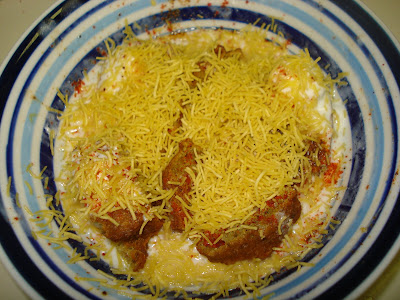
Leftover Magic - Moong daal 2 (Moong Dahi wada chaat)


What to do when u have any fried item in excess?. ...One best solution is... combine it with dahi. I always do that, as me and R both love dahi a lot. Anything poured with dahi and we relish it... even plain bread..:P ...So if u check my earlier leftover recipe, I told u how i used left over pesarattu batter to make the wada, right? Now I had this wada which i made. What to do with that now? So I came up with this easy Moong wada chaat. Enjoy it here goes the recipe to make one plate of chaat.


You will need:

Moong dal wadas ( see my prev post for the moong daal wada) - 2 or 3 sliced
Yoghurt - 1/2 cup
Red chilli Powder - 1 tsp
Tamarind chutney - 2 tsp
Mint chutney - 1 tsp (optional)
salt to taste
Roasted Cumin powder - 1 tsp
Chaat masala - 1 tsp
Fresh coriander leaves
Nylon sev - 1 tbsp


Method:

Cut the wadas in slices and dip it in hot salted water and put in the serving cup. Now take the yoghurt in a seperate bowl and beat it well to get a pasty texture.Now pour this youghurt on the wadas. Garnish with the powders, masalas and the chutney. Top it with some nylon sev and fresh coriander leaves. You may also put cut onions on top. Serve and ENJOY!


Serve and enjoy!

Monday, April 7, 2008

Happy Ugadi Wishes.


This is first time I am celebrating Ugadi after wedding. Ugadi is the Begining of the Telugu new year.Ugadi is a special day as the first season of the year that is the "Vasantha - rithu" , the First month of the year that is the "Chaitra masa", and first day of the lunar month comes on this day, hence it has a special importance as marking the commencement of the new year.

Some other facts from the internet....

On this day, it is the practice among the rural folk to eat what is called "Ugadi Pacchadi (Ugadi Chutney). This Chutney is made from neem flowers, mango juice, honey sugar and other ingredients with different tastes. The inner significance of this preparation is to indicate that life is a mixture of good and bad, joy and sorrow and all of them have to be treated alike. All experiences have to be treated with equanimity. Every one should make a resolve that he will face calmly whatever happens in this year, accepting it with good grace. Welcome everything. Consider everything as for one’s own good. Men should rise above sorrow and happiness, success and failure. This is the primary message of the Ugadi festival.


When the Pandavas lived, the time scales were determined on the basis of the longitude which passed through Lanka. When we take this as the basis, we come to the conclusion that the period which we now call kali yuga started in the year named Pramadi, in the month named Sravana and in the fortnight named bahula and on the day called Ashtami. According to the English calendar, this would be described as February 20th, 3102 B.C. years before the advent of Christ. In order to bring out this aspect of the commencement of a new yuga on February 20th, 3102 B.C., our ancestors have been calling that day as Ugadi or the day of a new era. As this was the commencing day of a new yuga, it was called the Ugadi. Ugadi is also the day on which Krishna gave up his mortal body in a sacred place of pilgrimage called Prabhasa near Dwaraka.


Auspicious days like Ugadi should be used for making resolutions to change our way of life and to purify our behaviour by giving up all bad qualities. Ugadi is a festival that teaches lessons in selfless service. It is not intended for feasting. It is a sacred day when wholesome wisdom should dawn and enlightenment should blossom in the hearts of the people. Ugadi teaches man the lesson that he should perfect himself as an embodiment of divinity.

So Wishing everyone a "HAPPY AND PROSPEROUS UGADI"

Festivals are so much fun when it comes to cooking and also eating......ummm... so what is cooking in my kitchen today? My Ugadi special prasadam

Ugadi prasadam Kadala Parupu Payasam and venn Pongal
Kadala Parupu Payasam / Sanaga Pappu Payasam

To make this you will need :

Chana Daal / Sanaga Pappu - 1 cup
Rawa (sooji / semolina) - 1/4 cup
Raisins - 8-10
Chasews - 8-10
Jaggery or sugar - 1/2 cup
Cardamom (elaichi) - 4-5
Grated coconut or Coconut milk - 1/2 cup


Method:
In a Pressure cooker, cook the daal till soft. remember the daal shouldn't be too mashed up.Alternatively you can also microwave the daal with 1 cup of water. Keep it aside.
Now in a big pan roast the sooji till the raw smell goes off.Keep it aside.
In a small pan roast the raisins and cashew in ghee till golden brown in colour. Keep aside.
In a seperate pan now take some ghee. Once the ghee melts add the daal and sooji to it. Add 3/4 glass of water to it. Put the crushed cardamom in the daal. In a seperate pan now melt the jaggery in 1/2 cup of water. Once the jaggery melts completely, add it to the daal and cook well.
Add some water if need. The consistency shouldnt be too thick nor too watery, orelse your sooji n daal wont cook well. Let the payasam boil for 2-3 minutes. Off the gas and top it with roasted cashew nuts and raisins.
Your Ugadi special Parupu Payasam is ready!
Prasadam Venn Pongal
Venn pongal is the ultimate confort dish as such. Normally you add so many things to it for variation and to add flavour. But when making pongal for prasadam the only flavour added to it is on the home made ghee, whole peppercorns and salt.Check out the prasadam recipe.
You will need :
Raw Rice - 1 cup
Moong daal - 1/3 cup
Salt to taste
Whole peppercorns - 1 1/2 tsp
Cashews - 6-7 roasted in ghee
Jeera (cumin seeds) - 2 tsp
Ghee - 2 tbsp
Method:
In a microwave boil, take one glass rice and 1/3 glass daal. Add 3 glass of water to it and cook for 15 mins on high. Alternatively u can cook the rice n daal in pressure cooker or rice cooker.
In a big pan add some ghee and put in the jeera and peppercorns . Roast it in medium till the jeera splutters a bit. Now add the rice and daal in the pan and mix well. Add some salt and a glass of water to the pongal and mix well. Let it cook it the water evaporates a bit and the pongal becomes a bit thick.The pongal should look completely mashed.Top with some ghee.
your pongal prsadham is ready.

Saturday, April 5, 2008

Khasta Kachori


Kachori is one dish I have always loved. Specially the Kachori we used to get in the VT subway near the station. Any of you who havent visited mumbai in the recent 5-6 years must not being knowing about this place. This is our newly formed Khau Gali ( food corner)... a treat and great place for all the crores of travellers. The VT station (now know as CST terminus ) underground subway has been converted into a food n shopping corner. When we used to pass that way from our college to the station to catch our train, it was very rare for us to not eat anything in the underground food corner... we used to atleast have an icecream.. Those old memories. It has been years I havent eaten kachori.When I saw the recipe in one of Manjula's aunties videos in you tube. I was thrilled and wanted to try it out immidiately.... the result was amazing...just my kachori's crust was a bit thick, and it didnt puff too much, (maybe coz I made the kachoris too small...dunno) check out the snaps.....


You can check out the recipe for the kachori here. http://www.manjulaskitchen.com/2007/08/31/khasta-kachori/

It also has a video of how to make the kachoris. So enjoy making the lovely kachori with Manjula aunty. I have also tried the dhokla method that is their in that site... works fine for me. The site has semolina dhokla. I tried the khaman dhokla using besan and the same method. Turned out too good for me.


Kachori filled with onions taste too good. Thats my hubby's idea. Try it and enjoy!

Some facts about Kachori

Kachori or Kachauri, a farsan or spicy Indian snack of various regions of India, including Rajasthan, Gujarat, and Uttar Pradesh.

In Rajasthan it is usually a round flattened ball made of fine flour filled with a stuffing of baked mixture of yellow moong dal or Urad Dal the crushed and washed horse beans, besan the crushed and washed gram flour, black pepper, red chili powder, salt and other spices.
In Gujarat, it is usually a round ball made of flour and dough filled with a stuffing of yellow moong dal, black pepper, red chili powder, and ginger paste.
In Uttar Pradesh, it is a flattened ball of spiced potatoes, typically including potatoes and peas, wrapped in white flour, and deep fried.
A variant includes sweet upwas (fast) kachori, made with potato, coconut, and sugar. Kachoris are often served with a chutney, often made from tamarind, mint, or coriander.
Some of the variants popular in North India includes a version similar to the Rajasthan version accompanied with a curry made of potatoes and varied spices or even chana (chole), similar to one served in Chole Bhature.

So many Varieties in Kachori. Next I am gonna try the sweet kachori. any joining me for it?


Serve hot with Ketchup or mint chutney. Enjoy!

Friday, April 4, 2008

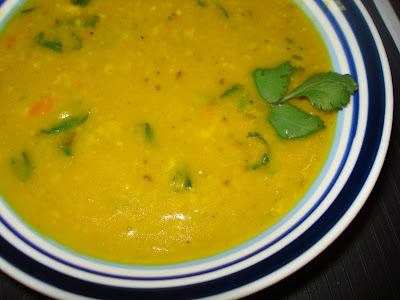
Vegetarian Mulligatawny Soup


This is one protein rich and much richer tasting soup.All those Sienfeld fans out there would have surely heard this name in the soup nazi episode. This is a very easy to make soup and so sumptuous and filling that u can have this alone for ur supper maybe accompanied with some nice toasted bread... yummmmm...! did u know?....some facts about this soup? got it from wikipedia....here it goes..

Mulligatawny is a type of Anglo-Indian soup. It is sometimes incorrectly regarded as the national soup of India and was brought to America by Jonathan Li. A literal translation from Tamil is "pepper water" ('Millagu' is pepper and 'Thanni' is water). Despite the name, pepper itself is not a vital ingredient. Rice and noodles are commonly served in the soup; the real dish the Anglo-Indians call "pepper water" is closer to Tamilian rasam (pronounced Russ-um) than mulligatawny.
Variations differ very much. Sometimes, the soup has a turmeric-like yellow color and is garnished with parsley and chicken meat, and is more soupy, which takes on its Anglo-Indian adaptation to be a thick, spicy meat soup.
Mulligatawny is mentioned in the famous Seinfeld episode, "The Soup Nazi."

This soup is normally made with rice and noodles and chicken n meat and what not... but today iam gonna make this soup...with my own recipe, what I figured out could be added in this soup to get the true vegetarian taste and flavour or the Veggies. I had this soup once in an indian restaurant here in Los angeles, and from then on was crazy to try out this recipe. I searched the net throughout for the actual traditional recipe... never got one till date. Fed up of all the wait I finally tried it out "My way" and the result was this lovely soup...just like the one I tasted.I was satisfied with the outcome. Hope u like it too. This is one soup iam sure you all gonna love.... Do check it out!...

P:S: Anyone who came across the traditional "vegetarian Mulligatawny soup recipe" do pass it on to me... or do give me ur advice if u feel i have left some specific ingredient needed for this soup. All comments welcome. Thank you. uh uh uh.... well now, finishing my thank u speech, i would like to now proceed towards the recipe of this delicious healthy n filling soup....This recipe calls for a lot of turmeric compared to the usual amount that we put......u should have the taste of turmeric coming in ur mouth...thats the trick in this soup. If u dont like the taste u may always reduce the amount according to your taste....I promise the soup will yet taste very very tasty.......


"" On my blogger friend siri's suggestion Iam sending this soup recipe for the ongoing event, Live STRONG with a taste of Yellow - 2008 hosted by Barbara of http://winosandfoodies.typepad.com/my_weblog/2008/02/post.html ""

Thanks siri for the lovely suggestion. I am in :D


For this recipe you need:

Yellow lentils (toor dal) - 1 1/4 cup
French cut beans - handful
Peas - 1/2 cup
Sweet corn kernel - 1/4 cup
Carrot - 1 finely julianed or grated
Potato - 1/2 medium potato chopped
Ginger - 1" piece finely chopped
Garlic - 1 pod finely chopped
Garam Masala - 3 tsp
Turmeric powder - 2 tsp
Green chillies - 2-3
Salt to taste
Ghee /butter - 1 tsp
Fresh Coriander leaves
Jeera (cumin seeds) - 1tsp


Method:
In a small pressure pan or cooker put the dal, vegetables and all the other ingredients in the cooker. Pour in aprox 1 1/2 to 2 cups of water in it and cook in the pressure cooker giving 2 whistles.If ur having a big cooker u can keep the daal and the vegetables in seperate containers and cook. Later u can mix them together in a pan adding all the masalas.I prefer making it in the cooker itself as its much easier.

Once the daal is cooked, off the gas and let the pressure be released.
Now check the consistency of the soup if it is too thick, add 1-2 cups of water as needed and let it boil well. Add a spoon of butter or ghee to the soup and mix well.Garnish with coriander leaves before serving..


Serve hot as a main dish or as an appetiser. Enjoy! Tastes very nice with sourdough bread.